A Bookseller’s Lot is Not An Easy One

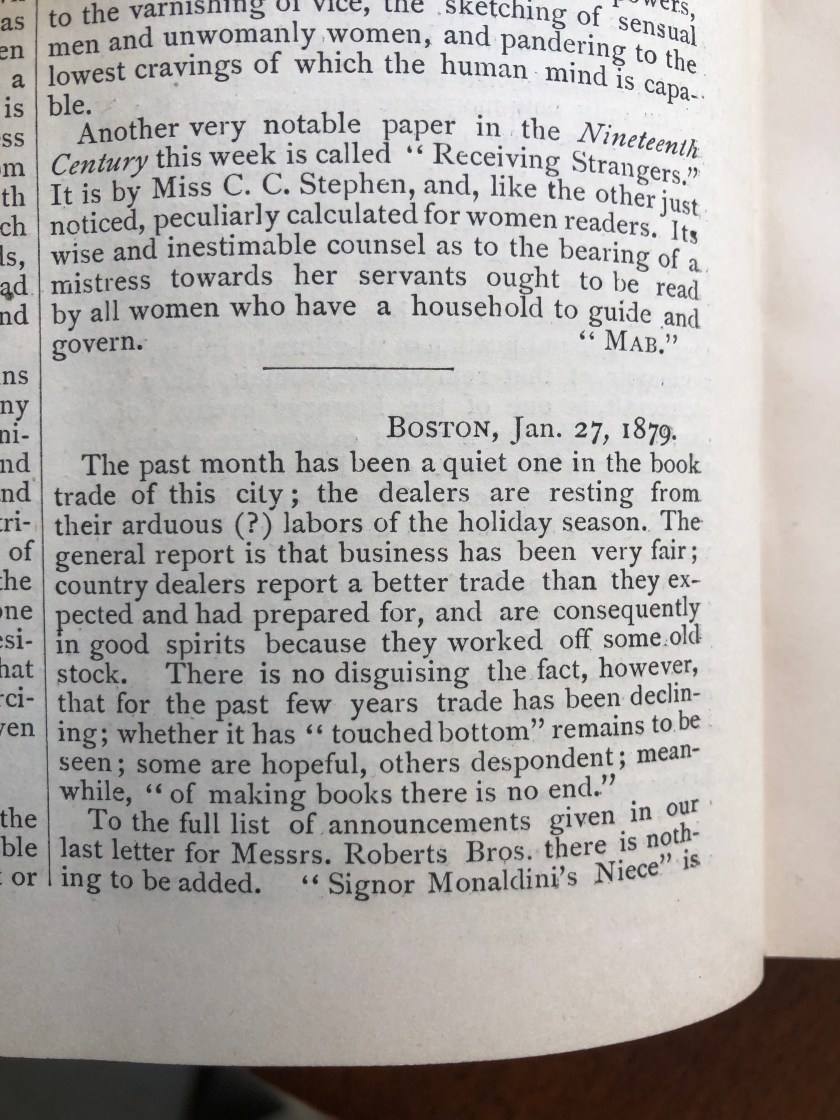
The world of publishing and bookselling has been in such turmoil in recent years that it’s tempting to assume that the business must have experienced better times in the past.  When I recently browsed through issues of The American Bookseller (published 1870’s and 80’s)  what struck me was the familiarity of their anxieties and problems.  The journal served “the Trade” through the last of the nineteenth century, covering everything of interest to booksellers, literary and music publishers, newsagents, and stationers.  The typography is quaint but the content is startlingly contemporary.

Copyright and trademark, especially international agreements, were contentious issues.  The quality of popular writing is lamented.  One reviewer complains that many women authors are shockingly forthright in their intention “to write what sells” rather than what is properly uplifting.  Sometimes business is good but the constant feeling and worry is that it isn’t as good as before.
img_0440

It surprised me to read that the practice of discounting from the stated retail price is already disturbing the tranquility of booksellers.  No one knows how to stop the publishers from giving price breaks to their biggest customers or how to discourage discounts offered by individual booksellers.  Price discipline is weakening, threatening the viability of bookselling in small shops.    Any shop owner experimenting with discounts, one commentator concludes, is playing a hopeless losing game.  “It would only enable the large dealer to crush still more remorselessly the small dealer.”

Happily, “of making books there is no end”, nor of people who love them and want to share them in the community of readers.  I mostly buy books in stores rather than order online, but that’s not always possible.  When I do need to buy a book online, however, I always now order from a real bookstore.  I have a short list of stores that I’ve found in travel around the country and particularly like – Lowry’s Books in  Three Rivers Michigan, Bookstore1 in Sarasota, Maria’s in Durango, and Skylight in LA – and I am happy to give them the business.  If I’m using an aggregator site like Abebooks (not ever the other A site) looking for an out-of-print title, I carefully search through the seller descriptions to identify a professional bookseller with a physical shop.

I enjoy so much just browsing in a bookstore and fairly wallowing in the variety and quantity of choices.  They can’t survive, though, without customers.  I will do what I can to keep them going and encourage other booklovers to do the same.  It would break my heart to live in a world without bookstores.

Is That A Fish In Your Ear?

David Bellos subtitled his book “Translation and the Meaning of Everything” and meant it.  It’s a brisk, occasionally head-spinning, always interesting survey of the nature of Language as the tool of human expression and communication and of the inherent challenges of understanding each other across the boundaries of particular languages.

I can’t say for certain that it was the first work in translation that I read, but I distinctly remember one Saturday morning pausing in my assigned chores to pull The Three Musketeers from the family bookcase – just to see what it was like –  and losing myself for hours in the thrilling world of Dumas.  I did have to finish the dusting, but the world had suddenly become larger, more glamorous and variable than I had known.

As I’ve continued to read the literature and watch movies/tv from as many countries as I can, the work of translation has become interesting in itself.  An early awakening to the difficulties of that work came with my discovery of Hong Kong movies, whose subtitles in the early years were rendered into astonishingly poor English.  My book group years ago read Pedro Paramo by Juan Rulfo and found ourselves more than usually divided in opinion.  In discussion we realized that members had read two different translations.  We definitely preferred one over the other but had to wonder if one was “truer” to the source or if you can even evaluate that.  I recently read a delightful book One Hundred Frogs by Hiroaki Sato in which he compiles more than a hundred translations of the poem Old Pond by the haiku poet Basho.  It reminded me that language always carries multiple meanings.  The translator tries to carry as much of that multiplicity into the new language as possible.

There are more than five thousand languages in use today, certainly more “major” ones than anyone can master.  Even linguists depend on translation.  So what is it? how is it done? what makes a “good” translation?  And more questions, what is language? how does one differ from another? what kinds of meanings are carried in structure? even, what is wordness?  Bellos explores these and many more with a wealth of historical anecdotes and contemporary statistics.

A particularly interesting chapter discusses the different structural qualities of languages and their implications for thinking and expression.  These create what the linguist Edward Sapir called mind grooves or habitual patterns of thought.  But this doesn’t mean that the meaning of one language cannot be expressed in another or that a language is “primitive” if structured differently from ones own.

Different languages, because they are structured in different ways, make their speakers pay attention to different aspects of the world.

The mind grooves laid down by the forms of a language are not prison walls but the hills and valleys of a mental landscape where some paths are easier to follow than others. 

To expand our minds and to become more fully civilized members of the human race, we should learn as many different languages as we can.  The diversity of tongues is a treasure and a resource for thinking new thoughts.