A Bookseller’s Lot is Not An Easy One

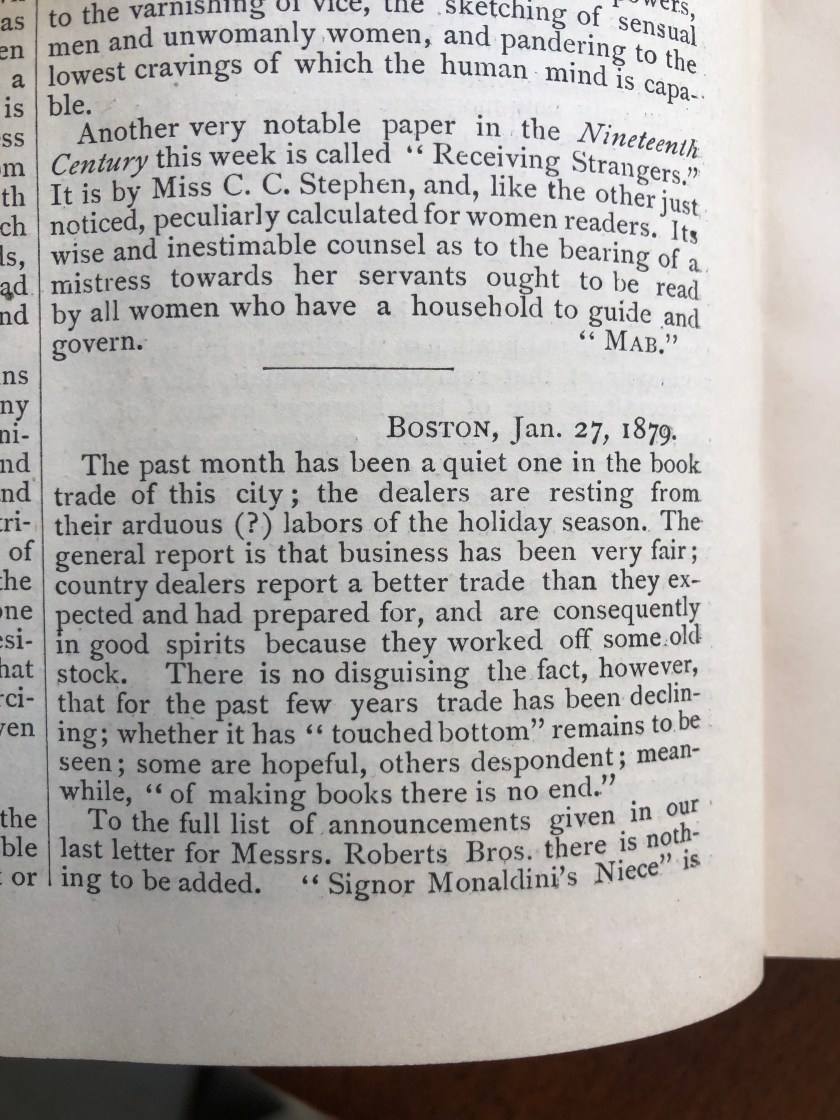
The world of publishing and bookselling has been in such turmoil in recent years that it’s tempting to assume that the business must have experienced better times in the past.  When I recently browsed through issues of The American Bookseller (published 1870’s and 80’s)  what struck me was the familiarity of their anxieties and problems.  The journal served “the Trade” through the last of the nineteenth century, covering everything of interest to booksellers, literary and music publishers, newsagents, and stationers.  The typography is quaint but the content is startlingly contemporary.

Copyright and trademark, especially international agreements, were contentious issues.  The quality of popular writing is lamented.  One reviewer complains that many women authors are shockingly forthright in their intention “to write what sells” rather than what is properly uplifting.  Sometimes business is good but the constant feeling and worry is that it isn’t as good as before.
img_0440

It surprised me to read that the practice of discounting from the stated retail price is already disturbing the tranquility of booksellers.  No one knows how to stop the publishers from giving price breaks to their biggest customers or how to discourage discounts offered by individual booksellers.  Price discipline is weakening, threatening the viability of bookselling in small shops.    Any shop owner experimenting with discounts, one commentator concludes, is playing a hopeless losing game.  “It would only enable the large dealer to crush still more remorselessly the small dealer.”

Happily, “of making books there is no end”, nor of people who love them and want to share them in the community of readers.  I mostly buy books in stores rather than order online, but that’s not always possible.  When I do need to buy a book online, however, I always now order from a real bookstore.  I have a short list of stores that I’ve found in travel around the country and particularly like – Lowry’s Books in  Three Rivers Michigan, Bookstore1 in Sarasota, Maria’s in Durango, and Skylight in LA – and I am happy to give them the business.  If I’m using an aggregator site like Abebooks (not ever the other A site) looking for an out-of-print title, I carefully search through the seller descriptions to identify a professional bookseller with a physical shop.

I enjoy so much just browsing in a bookstore and fairly wallowing in the variety and quantity of choices.  They can’t survive, though, without customers.  I will do what I can to keep them going and encourage other booklovers to do the same.  It would break my heart to live in a world without bookstores.

still more on books and reading

(he) did not camp near the soporific letter nor contort himself with a foul translation characteristic of rustics, but by right of victory carried the meaning as if captive into his own language.       St. Jerome on translations by Hilary the Confessor


I remember clearly how we read back then.  The whole ecstasy of that youthful reading, it wasn’t reading, but galloping, racing through books.  We sought out the racehorse of action, direct speech, short, muscular expressions.  We hated the ritardandos, the descriptions of nature, who needed them…               Now I feel the need to stop, like an old man winded by climbing up a slope he used to take in three bounds.  The hidden pleasures of slowness.  I love to linger long over some “It was a pleasant May morning, the birds were shouting with song, the dew glowed beneath the sun’s soft rays…”

from The Physics of Sorrow by Georgi Gospodinov    translated from the Bulgarian by Angela Rodel


Reading Moby Dick

Every so often, when the interval between meetings will be longer than usual or when a consensus choice for next month doesn’t emerge or when, perhaps, we just feel a bit bolder one of my book group will look around and say, “what’s on your ‘to be read’ stack?” It’s an opportunity to pull out that giant Victorian novel (The Way We Live Now by Anthony Trollope) or serious social novel (The Street by Ann Petry) or unaccountably missed classic (Don Quixote by Cervantes).

One member asked if we were willing to read Moby Dick with her.  Another said she’d never read it either.  I admitted to reading it only a few years ago but had loved it and was eager to read it again.  The others had all read it a long time past and were ready to revisit.  So Moby Dick it is.  

A great book doesn’t require embellishment, of course, but often inspires it.  I had been lucky years ago to find a copy of the beautiful Random House edition (from the Lakeside  Press edition of 1000) illustrated by Rockwell Kent.  It was an extraordinary reading experience.


Curious about other fine editions, I learned of a 1979 printing by Arion Press with illustrations by Barry Moser.  I may never see one of the 265 original copies of that hand press edition, but The University of California offers a handsome trade edition.

Andrew Hoyem, the publisher of Arion Press, on the opening page:  “The wave of the ‘C’ of “Call me Ishmael” almost jumps out of the book like a Hiroshiga wave.”


Time to dive in…


more on books and reading

the act of reading makes it appear to us for the time that we have lived another life – that we have had a miraculous enlargement of experience       Henry James


…three aspects of the experience of reading fiction: language, the world, and the extension of our sympathies toward other selves.  

We don’t read ‘in order’ to benefit in this way (experience more reality) from fiction.  We read fiction because it pleases us, moves us, is beautiful, and so on – because it is alive and we are alive.       James Wood


Paradoxically, at the same time as being able to be more self-indulgent by escaping into a world where no one can reasonably expect us to do anything, we have the luxury of putting ourselves and our needs, wants, and fears aside for a while; by being more selfish in a book, we become less self-ish.         Ann Morgan

on books and reading

(from Zama, the Governor questions a clerk in his office.)

What are you writing?…A book?  Make sons, Manuel, not books… then the clerk, in a respectful tone, deeply convinced of his own words, said “I want to realize myself in myself.  I don’t know what my children will be like.”  The governor hesitated…”Books? Ha, Ha!  Worse than children.” …(Manuel) managed to say, “Children realize themselves, but whether for good or ill we do not know.  Books are made only for truth and beauty.”  “That’s what you believe, what authors believe, but readers don’t see it like that,” came the ready retort.       Antonio di Benedetto


…like no other human creation, books have been the bane of dictatorships…the history of reading is lit by a seemingly endless line of censors’ bonfires.       Alberto Manguel


One writes only half the book; the other half is with the reader.                                            Joseph Conrad