…time has solidified

It’s only natural for a man, full of regrets and knowing he’ll die within hours, to be weak and make impossible requests. And then it’s equally natural for the person tending to that man to put on a cheerful front…so as not to let the dying man feel that he has been abandoned. Our final moments in this life aren’t generally an appropriate time for clear-eyed reflection; indeed, they always find us at our most sentimental. There’s no room left in them for rational thought, because time itself has solidified and expanded inside them like water becoming ice.

Khaled Khalifa from Death is Hard Work

a campaign worker’s lot is not a happy one

Yamasaki always wagered that he would be disillusioned; it was as if he kept up a constant bet with his youthful hopes. Yamasaki ranked as a genuine veteran in election campaigns, and he was absolutely indomitable, but a kind of masochistic fervor lodged within him. Corruption in an election or the victory of moneyed power did not in the lease surprise him; they seemed as natural as stones and horse dung along a road…(he was an) epicure of disillusion

After The Banquet by MISHIMA Yukio

Politic$

The enemy’s victory was achieved entirely thanks to sinister machinations and money…a tremendous flood of money…swirled through the streets with manic frenzy … The money shone like a sun through the clouds, an evil, baleful sun. And while it winked in the sky, plants with poisonous leaves wide-spread grew thick, and rank grasses, cropping out in every direction, stretched sinister feelers from here and there in the city toward the clear summer sky.

After The Banquet by MISHIMA Yukio

Looking back, from A Month In The Country

…at such a time, for a few of us there will always be a tugging at the heart–knowing a precious moment gone and we not there.

We can ask and ask but we can’t have again what once seemed ours for ever–the way things looked, that church alone in the fields, a bed on a belfry floor, a remembered voice, the touch of a hand, a loved face. They’ve gone and you can only wait for the pain to pass.

All this happened so long ago. And I never returned, never wrote, never met anyone who might have given me news of Oxgodby. So, in memory, it stays as I left it, a sealed room furnished by the past, airless, still, ink long dry on a put-down pen.

But this was something I knew nothing of as I closed the gate and set off across the meadow.

A Month In The Country by J.L. Carr

For All The Gold In The World, a Mediterranean Noir

For the umpteenth time I came to the conclusion that families are complicated and that everything becomes clear only when it’s too late. And then all you’re left with is time to waste on your regrets.

I am very happy to meet Marco Buratti aka”the Alligator”, a self-styled “free man with an outlaw heart”, in the series of novels by Italian author Massimo Carlotto. Writers in many countries have adopted/adapted the style and themes of noir crime fiction to tell stories of their own contemporary urban world. It’s been exciting recently to find several small presses (Pushkin Press, Bitter Lemon, Europa’s World Noir series) offering some really fine Noirs in English translation.

The elements of the genre – a world-weary flawed detective, laconic style, interior monologue – easily fall into cliche or even parody. These novels are utterly dependent on the author’s skill with language. Tone is everything. In the hands of a real craftsman, the Noir combines the pleasures of a complex story with the satisfactions of philosophical reflection.

Here is the Alligator reflecting after the not altogether happy resolution of For All The Gold In The World:
I kept on keeping on while waiting for another case where we’d need to step in to help straighten things out. The solution was almost never as simple as determining truth. We needed to protect our clients’ interests and, as much as possible, put things right, while respecting the rules of free men with outlaw hearts.

The opening quotation about regret is classic noir, taken from the scene below.

I sighed. It had been a little more than twenty-four hours and I was already standing up my new girlfriend.
She was at work and I couldn’t call her. I wrote her a text in which the word “sorry” appeared three separate times.
I turned around and, since I was definitely running early, I left the highway and drove to a multiplex. I had no idea which movie to watch, basing my decision more or less on showtimes. I chose a movie by an Italian director. A famous multiple award-winning director. I’d always been deeply grateful to the auteur school of filmmaking, which had put me in touch with aspects of life I knew nothing about. I often left the theater shaken, sometimes filled with wonder. The movies fed me with stories of the civilian world, as we referred to it, and helped me to understand ordinary people. But I felt no envy. Their world was still one I didn’t like. Unlike Max the Memory, I’d never cherished the dream of changing it. I preferred to live on its outskirts.
That afternoon I was sucked into a story of old age and death, told with great delicacy. I sat there as the end titles scrolled past and was the last to leave. I leaned on my car and smoked a couple of cigarettes, immersed in memories of my early life, the life that ended the day I wound up in prison. For the umpteenth time I came to the conclusion that families are complicated and that everything becomes clear only when it’s too late. and then all you’re left with is time to waste on your regrets.
“You can’t change the past,” I muttered under my breath, pulling open the car door and rushing to slip the CD into the player…The memories slipped from my mind. [the music] had managed to persuade the past to grant me a truce.

a recipe for a good old age

When asked the recipe for a good old age, I often give a list “good genes, good luck, enough money, and one good kid usually a daughter”.

Elderhood: Redefining Aging, Transforming Medicine, Reimagining Life
by Louise Aronson, MD

Despite our bravado or fear, most of us will be old and many of us very old. Aronson would have us embrace this stage of life and proposes it be recognized as distinct, but no less valued, from childhood and adulthood. She exposes the inadequacy and outright wrong-headedness of standard medical practice with respect to the biological differences of the older body and the kinds of services that the elderly need to be healthy and to maintain their lives.

Most of us probably want to blur the boundary between middle-age and old, but, however reluctantly, I have to acknowledge that I am crossing it. My husband is in the middle phase of Elderhood and my parents in the late, giving me a pretty good view of life in the last decades. Aronson’s book is very affirming for the dignity and value of each person at every stage of life. She condemns the view of old age as just a series of diminishments and losses. Elders in most times and cultures have been respected for their experience and service; she cites studies which show the greatest levels of happiness and life satisfaction among those in their 70s and 80s.

Aronson gives a withering critique of the medical services industry in the treatment of the elderly patient. I’ve encountered enough of what she describes to be nodding my head as I was reading. The phrase “health care” is beyond ironic when applied to the inappropriate, unhelpful, and violent treatment that so often is what the old experience in the medical system.

I will be recommending this book to everyone. It gives a very positive corrective to the prejudices and fears around aging and much good advice about securing good care until her call to “transform medicine” is realized.

Aronson’s recipe for a good old age is amusing, but has an edge. Whatever the positives in aging are or may be, inevitably our bodies will have problems and need care. Why does the medical establishment have to make things so much harder than they need to be?

The Bookcase Project (TBP) 1 Tolkien’s The Lord of the Rings

There was no suspense about the inaugural book of this collection review project. I chose The Lord of the Rings, a book special to me for multiple reasons and secure in its continued place in the Bookcase. I’ve read it only twice earlier, I think, possibly three times but it had been quite a few years in any case since the last time.

It’s special, in the first place, because it’s a truly wonderful book and a thrilling read each time. Tolkien’s singular achievement was to infuse his scholarship (languages, medieval literature) into a high fantasy story. He created a Heroic Romance for the modern reader, one that engages our emotions as well as our imaginations. Of course I remembered the humor and the great characters, but I had not remembered the sheer propulsive quality of the story or the pleasures of his descriptive language. When the great horse Shadowfax ran fire flew from his feet and the night flowed over him like a roaring wind.

It was good to recover the text, too, as the films were muddling my memories. I like much of the movie adaptation but there are, in my opinion, serious flaws. Everything with Arwen is made up for the movies and is entirely a mistake (true, the ride with Frodo to the ford is terrific but she doesn’t need to be there). That I dislike, but what I loathe are the Gondor scenes. The whole lip-smacking meal while the fair knights go to their doom sequence is the worst kind of overwrought cliche. Why make up something so lame when there’s plenty of good material available in the book?

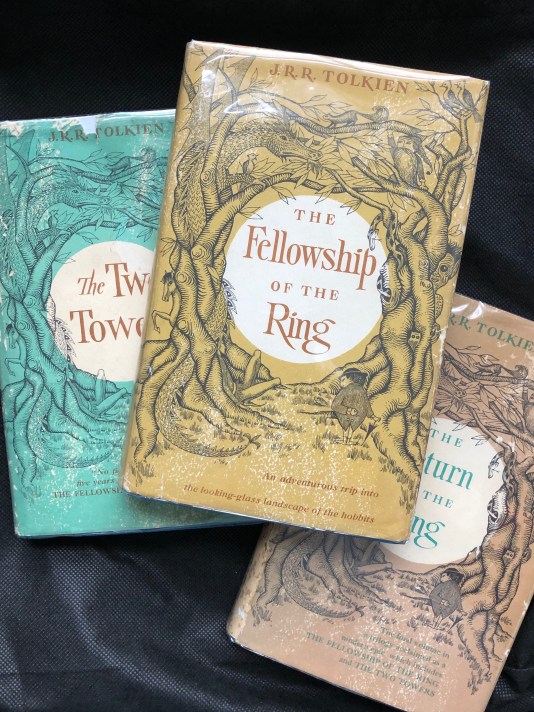
My copies of the three books are early printings of the American edition from Houghton Mifflin. I bought them as a retirement gift to myself.img_0621

The pleasures of rereading are different from the first time, of course; we never read the same book again. I really enjoyed returning to Tolkien’s world but it couldn’t ever compare to the overwhelming experience of the first encounter in 1973. The book was becoming a cult favorite on college campuses and among the rather small audience, at the time, for science fiction/fantasy work. I’d heard of it but didn’t know anything about the story and wasn’t particularly interested. Then my fiancé expressed surprise that I hadn’t read it and pressed his copy into my hands. “I’m not sure I could marry someone who didn’t love this book” or similar words accompanied it.

I was pretty sure he wasn’t serious about that, but I couldn’t help but feel a touch of anxiety as I opened the first volume. Happily on all accounts I was immediately gripped by the story and delighted with this marvelous new world. My marriage was saved and I had discovered a genre of fiction that has continued to give me pleasure through the many subsequent years.

The Bookcase Project

“If it’s books, it’s not hoarding”

I saw that on a T-shirt so it must be true. But it’s not easy to put limits on the number of books to have in the house, though limits there must be. I have a semi-ridiculous number of books that I think I will somehow have time enough to read in this life, but they stay quietly out of sight in various nooks and corners. But once a book has been read…to keep or not to keep? That is the question.

I’m not a book collector. My husband is. He has specific limited topics of interest and rarely retains any title that doesn’t enrich the extensive collections he has built. I used to say that I just accumulated books, but that’s a little harsh and not completely true. Now I might call myself a book keeper. I keep books, not too many, mostly fiction, ones that have particular meaning for me.

It’s not possible or rational to keep every book that I’ve enjoyed or admired. I do make good use of my public library and feel confident that many titles that I might have an urge to reread are readily available. I love Dickens but have no space for his collected works; I keep Bleak House and a charmingly illustrated The Pickwick Papers and let the rest hover out of reach but available. I give disproportionate space to works by lesser known authors or more obscure titles that would be difficult to recover if the whim should prompt it. It took me years to find a copy of The Greatest Slump Of All Time by David Carkeet and I’m not about to let go of it.

There are some books that are special for other reasons. I could readily find a copy of Moby Dick when I want to read it again but I love the Modern Library edition illustrated by Rockwell Kent. Again, not about to let go of it. I have a few comfort books, ones to read when I need a lift or a laugh, and a few with sentimental associations. The copy of Austen’s Emma is nice enough but unremarkable. But I treasure it as the gift from my future husband when we were on our first date. He took me to a used bookstore – some things are just meant to be!

So, those are reasons to keep a book, but we still have to deal with the question of limits. Years ago I decided to dedicate one bookcase to these special-to-me books, six shelves and no more. There’s some movement on and off, new discoveries sometimes nudge an older one from its place. Sometimes I have double-shelved a little or laid a book across the tops of others, honoring the letter of the law if not the spirit. But it’s worked well for me. It makes me happy to have special favorites where I can see them every day.

Now I feel the urge to revisit these books, for pleasure and for curiosity. Some I’ve only ever read once and I’d like to know if I will respond in the same way. Others I would just like to spend time with again, like The Lord Of The Rings. It was hard to justify rereading a book when my reading time was more limited. Retirement has given me this great opportunity to read more, like I haven’t since those golden childhood summer vacations.

The “Bookcase Project” is my plan to read my way through this assortment of books, with no timetable, in no particular order. It will be fun and interesting to see which ones maintain a place on the shelf.
Walking the Moor

Today the light was so erratic that the heather’s tones were elusive…And so the promise of colour to come was part of what I was seeing; and yet this rough carpet seemed to swallow light. The dark heather, with its dark roots, and beneath the dark roots the dark earth. Even the footpath puddles were black. Strung across a fence were seven scraps of brightly coloured cloth — these were Tibetan prayer flags, sanctifying the peaty air. The colour, against the moor, was pungent.

William Atkins from The Moor: A journey into the English wilderness

Resolution for a new year

“Always after a defeat and a respite, the Shadow takes another shape and grows again.”

“I wish it need not have happened in my time,” said Frodo.

“So do I,” said Gandalf, “and so do all who live to see such times. But that is not for them to decide. All we have to decide is what to do with the time that is given us.”

J.R.R. Tolkien
The Fellowship Of The Ring

Be Brave. Be Kind. Be True.