Every cliche (and a cliche is nothing more than an abstraction that has swallowed its own tail) becomes dangerous when it’s made literal.
from The Physics Of Sorrow by Georgi Gospodinov
Every cliche (and a cliche is nothing more than an abstraction that has swallowed its own tail) becomes dangerous when it’s made literal.
from The Physics Of Sorrow by Georgi Gospodinov
The world of publishing and bookselling has been in such turmoil in recent years that it’s tempting to assume that the business must have experienced better times in the past. When I recently browsed through issues of The American Bookseller (published 1870’s and 80’s) what struck me was the familiarity of their anxieties and problems. The journal served “the Trade” through the last of the nineteenth century, covering everything of interest to booksellers, literary and music publishers, newsagents, and stationers. The typography is quaint but the content is startlingly contemporary.


Copyright and trademark, especially international agreements, were contentious issues. The quality of popular writing is lamented. One reviewer complains that many women authors are shockingly forthright in their intention “to write what sells” rather than what is properly uplifting. Sometimes business is good but the constant feeling and worry is that it isn’t as good as before.
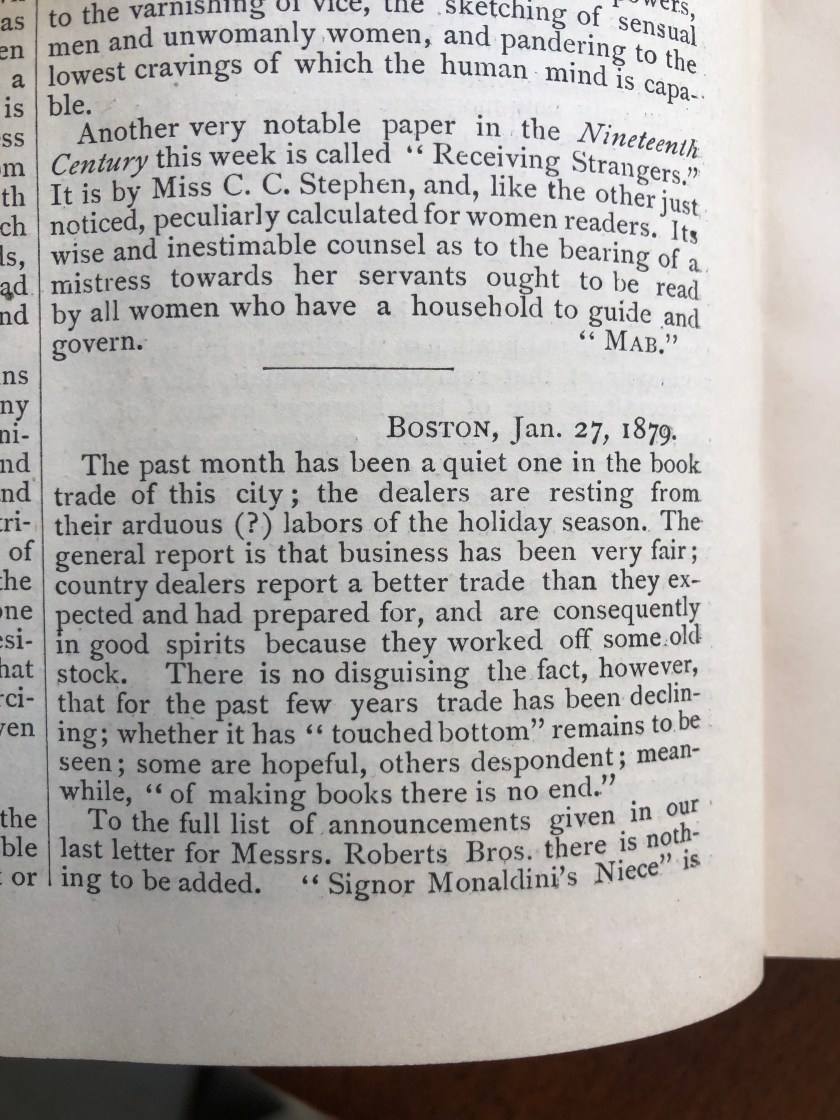
It surprised me to read that the practice of discounting from the stated retail price is already disturbing the tranquility of booksellers. No one knows how to stop the publishers from giving price breaks to their biggest customers or how to discourage discounts offered by individual booksellers. Price discipline is weakening, threatening the viability of bookselling in small shops. Any shop owner experimenting with discounts, one commentator concludes, is playing a hopeless losing game. “It would only enable the large dealer to crush still more remorselessly the small dealer.”
Happily, “of making books there is no end”, nor of people who love them and want to share them in the community of readers. I mostly buy books in stores rather than order online, but that’s not always possible. When I do need to buy a book online, however, I always now order from a real bookstore. I have a short list of stores that I’ve found in travel around the country and particularly like – Lowry’s Books in Three Rivers Michigan, Bookstore1 in Sarasota, Maria’s in Durango, and Skylight in LA – and I am happy to give them the business. If I’m using an aggregator site like Abebooks (not ever the other A site) looking for an out-of-print title, I carefully search through the seller descriptions to identify a professional bookseller with a physical shop.
I enjoy so much just browsing in a bookstore and fairly wallowing in the variety and quantity of choices. They can’t survive, though, without customers. I will do what I can to keep them going and encourage other booklovers to do the same. It would break my heart to live in a world without bookstores.
(he) did not camp near the soporific letter nor contort himself with a foul translation characteristic of rustics, but by right of victory carried the meaning as if captive into his own language. St. Jerome on translations by Hilary the Confessor
I remember clearly how we read back then. The whole ecstasy of that youthful reading, it wasn’t reading, but galloping, racing through books. We sought out the racehorse of action, direct speech, short, muscular expressions. We hated the ritardandos, the descriptions of nature, who needed them… Now I feel the need to stop, like an old man winded by climbing up a slope he used to take in three bounds. The hidden pleasures of slowness. I love to linger long over some “It was a pleasant May morning, the birds were shouting with song, the dew glowed beneath the sun’s soft rays…”
from The Physics of Sorrow by Georgi Gospodinov translated from the Bulgarian by Angela Rodel
A young mind is like a green field and full of possibilities, but an old mind becomes more and more like a cemetery crowded up with memories.
H. G. Wells
Every so often, when the interval between meetings will be longer than usual or when a consensus choice for next month doesn’t emerge or when, perhaps, we just feel a bit bolder one of my book group will look around and say, “what’s on your ‘to be read’ stack?” It’s an opportunity to pull out that giant Victorian novel (The Way We Live Now by Anthony Trollope) or serious social novel (The Street by Ann Petry) or unaccountably missed classic (Don Quixote by Cervantes).
One member asked if we were willing to read Moby Dick with her. Another said she’d never read it either. I admitted to reading it only a few years ago but had loved it and was eager to read it again. The others had all read it a long time past and were ready to revisit. So Moby Dick it is.
A great book doesn’t require embellishment, of course, but often inspires it. I had been lucky years ago to find a copy of the beautiful Random House edition (from the Lakeside Press edition of 1000) illustrated by Rockwell Kent. It was an extraordinary reading experience.


Curious about other fine editions, I learned of a 1979 printing by Arion Press with illustrations by Barry Moser. I may never see one of the 265 original copies of that hand press edition, but The University of California offers a handsome trade edition.


Andrew Hoyem, the publisher of Arion Press, on the opening page: “The wave of the ‘C’ of “Call me Ishmael” almost jumps out of the book like a Hiroshiga wave.”
Time to dive in…
the act of reading makes it appear to us for the time that we have lived another life – that we have had a miraculous enlargement of experience Henry James
…three aspects of the experience of reading fiction: language, the world, and the extension of our sympathies toward other selves.
We don’t read ‘in order’ to benefit in this way (experience more reality) from fiction. We read fiction because it pleases us, moves us, is beautiful, and so on – because it is alive and we are alive. James Wood
Paradoxically, at the same time as being able to be more self-indulgent by escaping into a world where no one can reasonably expect us to do anything, we have the luxury of putting ourselves and our needs, wants, and fears aside for a while; by being more selfish in a book, we become less self-ish. Ann Morgan
(from Zama, the Governor questions a clerk in his office.)
What are you writing?…A book? Make sons, Manuel, not books… then the clerk, in a respectful tone, deeply convinced of his own words, said “I want to realize myself in myself. I don’t know what my children will be like.” The governor hesitated…”Books? Ha, Ha! Worse than children.” …(Manuel) managed to say, “Children realize themselves, but whether for good or ill we do not know. Books are made only for truth and beauty.” “That’s what you believe, what authors believe, but readers don’t see it like that,” came the ready retort. Antonio di Benedetto
…like no other human creation, books have been the bane of dictatorships…the history of reading is lit by a seemingly endless line of censors’ bonfires. Alberto Manguel
One writes only half the book; the other half is with the reader. Joseph Conrad
From historical sources, myths and stories, and the poetry of Li Bai and his contemporaries, Ha Jin conjures a vivid personality in a richly detailed world a millennium past. The Banished Immortal, A Life of Li Bai draws us into the life of an extraordinary artist in the turbulent middle years of the Tang Dynasty. Li Bai never achieved the official recognition that he sought but his poetry was widely admired and loved. The nickname “the banished immortal” suggests it is so excellent that he must be a heavenly personage, banished to earth for some misdeed.
This short poem was chosen for the UN stamp set commemorating World Poetry Day.
Reflection In A Quiet Night
Moonlight spreads before my bed.
I wonder if it’s hoarfrost on the ground.
I raise my head to watch the moon
and lowering it, I think of home.
Another poem written for his uncle, a conscientious low-ranking official discouraged by court corruption.
Song For Accompanying Uncle Hua on Xie Tiao’s Tower
Yesterday, having left me, couldn’t be pressed to stay.
Today, still disturbing me, makes me more upset.
The long wind is sending the autumn geese far away,
And viewing them from this high tower, we should drink more.
Your essays are fresh and strong like those of the Han dynasty
While my poetry resembles Xie Tiao’s in vigor and beauty.
We both have lofty spirit, thinking of soaring
To the sky to grab hold of the clear moon.
I draw my sword to cut water, which won’t stop flowing,
And I raise my cup to douse my sorrow, which grows stronger.
Ah, life is such a sad thing that tomorrow
I will undo my hair and sail away in a little boat.
David Bellos subtitled his book “Translation and the Meaning of Everything” and meant it. It’s a brisk, occasionally head-spinning, always interesting survey of the nature of Language as the tool of human expression and communication and of the inherent challenges of understanding each other across the boundaries of particular languages.
I can’t say for certain that it was the first work in translation that I read, but I distinctly remember one Saturday morning pausing in my assigned chores to pull The Three Musketeers from the family bookcase – just to see what it was like – and losing myself for hours in the thrilling world of Dumas. I did have to finish the dusting, but the world had suddenly become larger, more glamorous and variable than I had known.
As I’ve continued to read the literature and watch movies/tv from as many countries as I can, the work of translation has become interesting in itself. An early awakening to the difficulties of that work came with my discovery of Hong Kong movies, whose subtitles in the early years were rendered into astonishingly poor English. My book group years ago read Pedro Paramo by Juan Rulfo and found ourselves more than usually divided in opinion. In discussion we realized that members had read two different translations. We definitely preferred one over the other but had to wonder if one was “truer” to the source or if you can even evaluate that. I recently read a delightful book One Hundred Frogs by Hiroaki Sato in which he compiles more than a hundred translations of the poem Old Pond by the haiku poet Basho. It reminded me that language always carries multiple meanings. The translator tries to carry as much of that multiplicity into the new language as possible.
There are more than five thousand languages in use today, certainly more “major” ones than anyone can master. Even linguists depend on translation. So what is it? how is it done? what makes a “good” translation? And more questions, what is language? how does one differ from another? what kinds of meanings are carried in structure? even, what is wordness? Bellos explores these and many more with a wealth of historical anecdotes and contemporary statistics.
A particularly interesting chapter discusses the different structural qualities of languages and their implications for thinking and expression. These create what the linguist Edward Sapir called mind grooves or habitual patterns of thought. But this doesn’t mean that the meaning of one language cannot be expressed in another or that a language is “primitive” if structured differently from ones own.
Different languages, because they are structured in different ways, make their speakers pay attention to different aspects of the world.
The mind grooves laid down by the forms of a language are not prison walls but the hills and valleys of a mental landscape where some paths are easier to follow than others.
To expand our minds and to become more fully civilized members of the human race, we should learn as many different languages as we can. The diversity of tongues is a treasure and a resource for thinking new thoughts.
The opening of Zama by Antonio Di Benedetto translated from the Spanish by Esther Allen
I left the city and made my way downriver alone, to meet the ship I awaited without knowing when it would come.
I reached the old wharf, that inexplicable structure. The city and its harbor have always been where they are, a quarter-league farther upriver.
I observed, among its pilings, the writhing patch of water that ebbs between them.
A dead monkey, still whole, still undecomposed, drifted back and forth with a certain precision upon those ripples and eddies without exit. All his life the water at forest’s edge had beckoned him to a journey, a journey he did not take until he was no longer a monkey but only a monkey’s corpse. The water that bore him up tried to bear him away, but he was caught among the posts of the decrepit wharf and there he was, ready to go and not going. And there we were.
There we were: Ready to go and not going.
In a nightmare/vision Zama sees horses in the street trample a small girl.
I withdrew. My boots dragged in the dirt; I could not lift my feet. Had my arms been longer, my fingernails, too, would have been encrusted with red earth…I know nothing more. Night, my benefactress, came to my tired body.
Later, Zama goes with a military detachment into the jungle.
The sun was a dog with a hot, dry tongue that licked and licked me until it woke me up.
 A Bookwoman’s Holiday